AI CRM for Real Estate Investors: Features That Support Acquisitions Teams
An acquisitions team rarely loses a deal because someone forgot what a motivated seller said. Deals slip because timing gets missed, follow-up stalls, messages go unanswered, or the lead sits in the wrong stage while everyone assumes someone else is handling it. That is why the conversation around an AI CRM for real estate investors has become more practical and less theoretical. The question is no longer whether automation belongs in an investor operation. The better question is which features actually help acquisitions teams work faster, stay organized, and keep seller conversations moving without creating compliance or deliverability problems.
For real estate investors, the CRM is not just a contact database. It is the operating system for lead management, follow-up, qualification, and handoff. A wholesaler handling off market property leads, a buy-and-hold operator working inherited property lists, and a fix-and-flip shop managing distressed seller leads all need the same core outcome: keep conversations alive until the lead is ready for a serious offer discussion. AI for real estate investors matters most at that point, where scale meets inconsistency.
A lot of tools claim to solve that problem. Fewer are built around the way investor businesses actually run. Acquisitions teams deal with inbound and outbound calls, text conversations, missed call response, lead qualification, and constant seller lead follow up. They also juggle property data, skip tracing for real estate investors, and multiple lead sources from PPC, SEO, cold calling, and SMS marketing for real estate investors. A generic CRM can https://rentry.co/hkfx6ycm hold records. It usually struggles to support the day-to-day pace of real estate acquisitions.
What an acquisitions team actually needs from a CRM
Most investor teams do not need a prettier dashboard. They need a real estate follow up system that reduces lag between first contact and live conversation. That sounds simple, but it is where many setups fall apart. A seller fills out a form at 8:40 p.m., gets no response until the next morning, then takes a call from another investor before your team has even opened the record. Or a lead responds to a text two weeks after an outbound campaign, and the reply lands in a rep’s personal phone instead of the investor CRM.
A strong real estate AI CRM supports speed, consistency, and visibility. Speed means the system can respond when the team cannot. Consistency means every lead gets follow-up rather than only the ones the acquisitions manager remembers. Visibility means management can see where leads are stalling, whether in contact attempts, qualification, appointment setting, or post-appointment nurture.
This is where AI lead follow up becomes useful in a grounded, operational sense. Not as a replacement for acquisitions judgment, but as a layer that keeps the pipeline moving between human touchpoints.
Unified communication matters more than most teams realize
Investor lead generation is fragmented by nature. Some leads call after seeing a website. Some answer a cold text. Some return a missed call. Some fill out a landing page and never pick up the phone. If those interactions live in separate tools, response times suffer and context gets lost.
A real estate investor CRM that combines calling, SMS, and follow-up workflows helps acquisitions teams keep the full conversation in one place. That matters because seller motivation often appears gradually. The first message might be vague. The second call reveals a timeline. The third text uncovers a probate issue or tenant problem. If each interaction is isolated, the rep who picks up next is starting half blind.
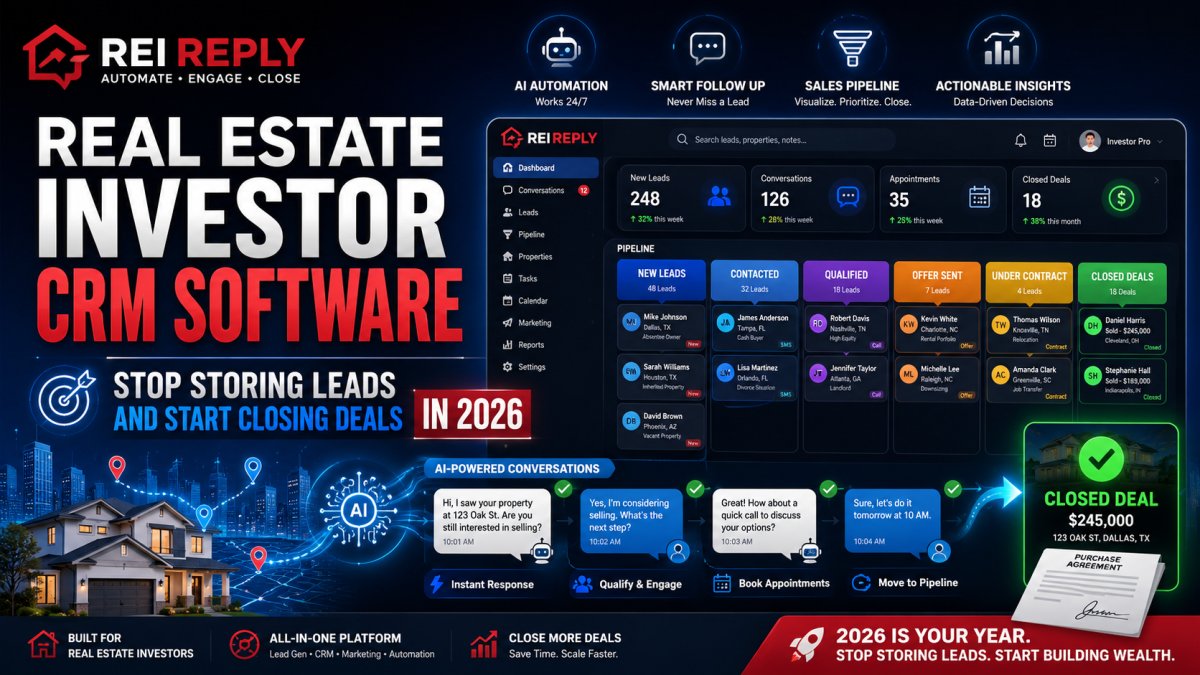
Investor-focused platforms have started to address this directly. REI Reply, for example, positions itself as a CRM and follow-up system built specifically for real estate investors. It combines inbound and outbound calling, SMS, missed-call text back, and AI voice assistants in one platform. That is a practical design choice for acquisitions teams. When the communication stack is unified, handoffs improve, context improves, and seller lead automation becomes easier to manage.
There is also a less obvious benefit. A single communication hub makes performance review more honest. Teams can see whether leads are really low quality or whether response delay and weak follow-up are the actual issue. I have seen plenty of operations blame lead quality when the real problem was simple: nobody answered quickly enough, and nobody followed up with discipline after the first attempt.
The best AI features support reps, they do not try to impersonate top closers
There is a big difference between useful AI real estate investing tools and gimmicks. Useful tools handle repetition, route conversations, and preserve momentum. Gimmicks promise to close emotionally complex seller situations without human judgment. Acquisitions leaders know the difference almost immediately.
For a real estate investor, the strongest AI lead management features usually sit at the top and middle of the funnel. They help answer inquiries, respond after hours, ask qualifying questions, book appointments, and continue outreach when a seller goes quiet. REI Reply’s marketing states that its AI voice agent can qualify leads, book appointments, and follow up around the clock across calls, SMS, email, and social channels. For acquisitions teams, that kind of coverage can reduce the dead air that kills opportunity.
That does not mean every seller should move from first contact to contract through automation. A voice AI for real estate investors can help gather information and maintain contact, but seller motivation is nuanced. Someone facing foreclosure speaks differently from someone testing the market after a divorce. A landlord tired of repairs needs a different conversation from an heir managing an estate. AI follow up works best when it moves the lead closer to a real human conversation with better context attached.
In practice, that means the CRM should capture what was asked, how the seller responded, whether an appointment was set, and when the next step should happen. If the AI voice agent or automated SMS keeps a lead warm until the acquisitions rep steps in, that is valuable. If it creates confusion or over-automation, the team ends up doing cleanup work instead of acquisitions.
Lead qualification is where automation earns its keep
Not every inbound inquiry deserves the same level of human effort. The problem is that many teams treat every new seller lead as urgent while ignoring the fact that urgency varies wildly. One seller wants a cash offer this week. Another is “just curious.” Another is impossible to reach by phone but responsive by text. Another has no real authority to sell.
Automated lead qualification helps sort that early. The goal is not to reject aggressively. It is to gather enough signal so the acquisitions team can prioritize correctly. Real estate lead qualification often revolves around timing, contactability, and whether the seller is willing to continue the conversation. Those details matter because acquisitions capacity is finite. If your top rep spends the afternoon chasing cold records with no engagement, hot leads wait too long.
AI lead qualification and automated lead qualification can support this triage process well, especially when paired with structured workflows. A seller who responds to SMS follow up but ignores calls might stay in a text-first nurture sequence. A seller who answers an inbound call and agrees to talk further can move straight to appointment scheduling. A lead that engages after hours can be acknowledged immediately rather than sitting untouched until morning.
For wholesalers and teams focused on real estate wholesaling software, this is especially important. Volume is often high, and speed-to-lead is part of the model. But even buy-and-hold operators benefit. The lead source may be different, yet the bottleneck is often the same: too many conversations starting, not enough progressing cleanly.
SMS is still one of the most practical channels, but only when it is handled correctly
There is a reason real estate investor texting remains central in lead generation automation. Sellers often ignore calls from unknown numbers yet reply to a short text. Texting also fits the stop-and-start nature of seller communication. People answer while at work, after dinner, during a break, or three days later with a simple “yes, who is this?”
That makes real estate SMS marketing and seller lead follow up powerful, but only if the system supports organization and compliance. An acquisitions team needs message history tied to the lead record, clear ownership, and automation that feels timely rather than robotic. Automated text messaging is not useful when it creates duplicates, sends at the wrong time, or leaves reps guessing whether a message was already sent.
Investor-focused platforms increasingly emphasize this. REI Reply advertises workflow tools such as automated follow-up, AI conversations, Spintax, and Humanizer or text-deliverability-oriented messaging features. Even without getting into marketing language, the underlying point is operationally sound. Real estate SMS automation is not just about sending more messages. It is about improving deliverability, managing conversation flow, and helping teams avoid stale, repetitive outreach that gets ignored.
The best SMS automation software for investors respects the reality that text is conversational. Motivated seller text messages need to feel relevant to the stage of the relationship. Early outreach should not sound like late-stage negotiation. Long-term nurture should not read like a final demand. And if a seller engages, the automation should yield to a human fast enough that the lead does not feel trapped in a loop.
Deliverability and compliance are not back-office details
A surprising number of investor teams treat compliance as a setup chore and deliverability as a technical nuisance. Both are central to performance. A text message nobody receives has zero value. A campaign that triggers legal issues can be worse than wasted spend.

In the United States, A2P 10DLC is the carrier standard for application-to-person SMS sent through 10-digit long code numbers. The point is verification and consensual messaging. For teams using SMS for real estate investors, that means registration and message practices are not optional details. They affect whether your texts reach people at all.

The same principle applies to call workflows. The FTC states that telemarketers must honor Do Not Call rules, cannot use National Registry or internal do-not-call lists for anything beyond compliance purposes, and generally may not call outside 8 a.m. To 9 p.m. Local time without prior consent. The FTC also states that prerecorded telemarketing calls require prior signed, written agreement, and that electronic consent can satisfy the requirement if E-SIGN standards are met. These are not abstract legal notes. They shape how real estate call automation and SMS lead generation should be configured.
A good AI CRM for real estate investors should make compliance easier to maintain, not harder. At minimum, acquisitions teams should expect the system to support responsible texting and calling workflows, maintain records clearly, and reduce the temptation to run scattered outreach from personal devices and disconnected tools.
Here are five features worth treating as non-negotiable when SMS and calling are part of your outreach strategy:
- A centralized conversation record for calls and texts
- Clear workflow controls for automated lead follow up
- Support for compliant business texting setup, including A2P registration where applicable
- Easy handling of opt-out and do-not-contact requests
- Visibility into who owns the lead and what the next action is
When teams skip these basics, the result is usually confusion dressed up as hustle.
Investor data is valuable only if it connects to action
Many teams chase bigger lists before they have a better process. More motivated seller data, more property owner lookup, more bulk skip tracing, more off market data. Those can all help, but data alone does not close anything. It has to feed a workable pipeline.
The verified context around REI Reply is useful here because it clarifies the platform’s role. It is presented as a conversion engine for leads already being generated, not simply a lead provider. At the same time, the company says a subscription includes access to verified motivated seller data through REI AI Leads. That distinction matters. Real estate investor software can support both lead generation and conversion, but acquisitions leaders should still ask a practical question: once a lead enters the system, what happens next?
If property data for real estate investors is disconnected from the communication workflow, the acquisitions team still spends too much time exporting, importing, and guessing. A more useful arrangement is one where lead data, seller conversations, and follow-up live in the same operating rhythm. That does not guarantee better deals, but it does make it easier to spot who needs contact now, who needs a different channel, and who should be nurtured over time.
Skip tracing for real estate investors is a good example. Finding a property owner phone number is only step one. The real work starts after contact data enters the system. Is the first touch a call, a text, or both? What happens if there is no answer? What happens if there is a callback at 7:30 p.m.? Who sees the reply? Which stage changes automatically, and which one requires a rep decision? The CRM earns its place in those moments, not in the list export.
Pipeline clarity keeps acquisitions managers from managing by memory
Ask any experienced acquisitions manager where deals usually bog down and you will hear versions of the same answer. Leads are not being contacted enough. Follow-up is inconsistent. Qualified conversations are happening, but next steps are vague. Appointments are set, then not confirmed. Older leads vanish because everyone chases the fresh inbound.
That is why real estate lead management and real estate sales pipeline design matter so much. An investor CRM should help a team separate fresh leads, active conversations, nurtures, no-contact records, and reactivation opportunities. It should also make it obvious when a lead has gone too long without a touch.
This sounds basic, but many investor businesses outgrow spreadsheets and generic CRMs precisely because those tools cannot enforce enough structure. Once a team has multiple acquisitions reps, VAs, callers, or managers, memory is not a system. Pipeline discipline is.
A practical AI acquisition assistant helps by reducing manual gaps. If the software can trigger seller lead follow up after a missed call, schedule text message marketing real estate sequences intelligently, and book appointments when a seller is ready, the acquisitions team gets more time for actual negotiation. That is the right division of labor. Let automation handle recurrence. Let people handle judgment.
The human side of seller conversations still decides outcomes
There is a temptation in real estate automation to chase total efficiency. More messages, more touches, more sequences, more automations. Yet motivated seller leads are not identical transactions moving through a warehouse. They are people in situations that are often messy, private, and emotionally charged.
That is why the best real estate AI supports the human side instead of flattening it. A seller who receives timely acknowledgment after submitting a form feels heard. A seller who can text back on their own schedule feels less pressured. A rep who opens the record and sees prior responses can pick up naturally instead of asking the same questions twice. Small operational improvements create a noticeably better seller experience.
And that experience affects conversion. Not because the software is magical, but because smooth communication builds trust. Trust does not replace price, terms, or timing. It does make sellers more likely to stay in the conversation long enough for those issues to be discussed properly.
How to judge whether an AI CRM is really helping your team
The easiest mistake is to evaluate real estate investor software by features alone. The better test is behavioral. Did response times improve? Did more leads receive consistent follow-up? Did appointments increase? Did no-contact records drop? Did reps spend less time on administrative cleanup and more time having real conversations?
A useful implementation tends to show up in a few places fairly quickly:
- Faster first response to inbound leads
- Fewer missed follow-up opportunities
- Better visibility into active seller conversations
- Cleaner handoffs between automation and acquisitions reps
- More disciplined use of SMS, calls, and nurture workflows
None of that requires fantasy claims about AI wholesaling or fully automated deal flow. It requires a CRM for real estate investors that fits investor operations, supports compliance-minded outreach, and helps teams do the obvious things well, every day.
For acquisitions teams, that is the point of an AI real estate CRM. Not to replace the rep who can build rapport with a difficult seller. Not to turn cold records into signed agreements by itself. The real value is steadier execution. Leads get answered. Conversations stay organized. Follow-up happens on time. Missed calls do not disappear. Qualification starts sooner. Appointments get booked faster. Managers can see what is happening without chasing updates in three different apps.
That is what makes AI tools for real estate investors worth paying attention to right now. When the technology is applied to the unglamorous parts of lead management, it can remove enough friction to help acquisitions teams perform like better versions of themselves. For a business built on speed, consistency, and seller communication, that is not a small improvement. It is often where the next few deals come from.